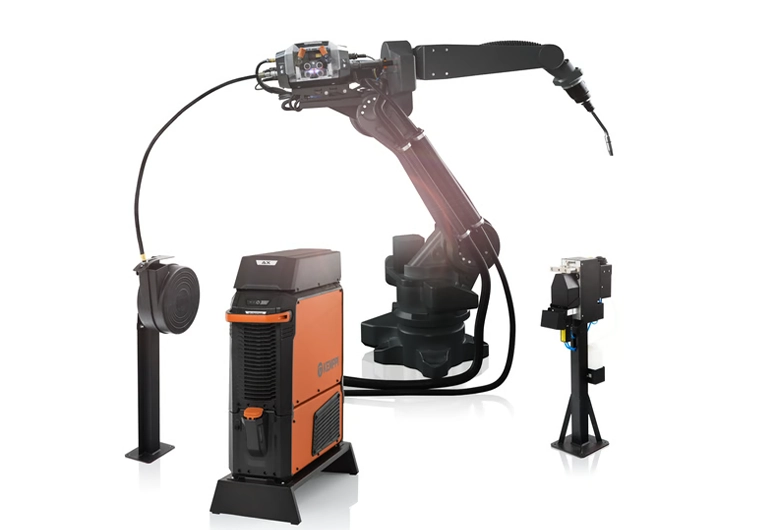
In today’s production processes, welding robots stand out as technologies that meet the efficiency and quality expectations of various industries. By minimizing welding defects caused by human error, they provide reliable solutions, especially for mass-production companies. For this reason, robotic technologies have become systems preferred not only by industrial giants but also by medium-sized enterprises.
Robotic systems are used in every field where metal joining is intense. With increased production capacity, businesses lower costs and accelerate production speed. In tasks requiring precise welding, they offer a high level of accuracy and bring product quality to global standards.
Robotic welding applications are widely used in the following industries:
- Automotive industry: Provides standard quality in mass production of chassis, bodywork, and exhaust systems.
- Shipbuilding and aviation industry: Offers reliable solutions for critical parts that require durable joints.
- Heavy industry: Creates long-lasting connections in steel construction, pipelines, and machinery production.
- Electronics and white goods production: Increases accuracy rates in the assembly of small and sensitive parts.
- Energy sector: Ensures safe welding in wind turbines, power plant equipment, and pipeline systems.
In short, robotic systems have become powerful tools that transform production lines in various industries. By using these technologies, businesses not only improve production quality but also enhance safety and gain a competitive advantage in the global market. Thus, robot-assisted welding solutions are positioned as a strategic investment for the industry of the future.
Eko Kaynak Robotic Welding Applications
In industrial production, the correct integration approach directly determines system performance. The automation solutions developed by Eko Kaynak are structured through project-based engineering analysis and configured according to site-specific parameters.
Increasing capacity requirements and tolerance expectations require planning beyond standard installations. For this reason, each project is modeled by considering workpiece geometry, tonnage distribution, and access distance.
At the initial stage, technical data analysis is performed and the load center is calculated. Then, the appropriate axis combination, load capacity, and movement distance are determined. PLC-supported control structures and digital speed indicators support system integrity. Thus, robotic systems are commissioned in compliance with site conditions.
Incorrect capacity selection or improper positioning may cause vibration, weld seam deviation, and time loss. To reduce these risks, test passes and load simulations are applied during the integration phase.
Decision criteria in projects are generally evaluated under the following headings:
- Load capacity: Selection of motor and reducer suitable for the weight distribution of the workpiece ensures stable movement.
- Movement distance: The working range of the column and boom is determined according to access requirements.
- Synchronization structure: Compatibility between PLC and external servo motors preserves system integrity.
- Safety components: Monitoring via limit switches and control panels supports operational safety.
Through correct configuration, high efficiency and high precision targets are achieved in projects.
For more detailed information about system scope, installation process, and integration details, you may visit our Robotic Solutions page.