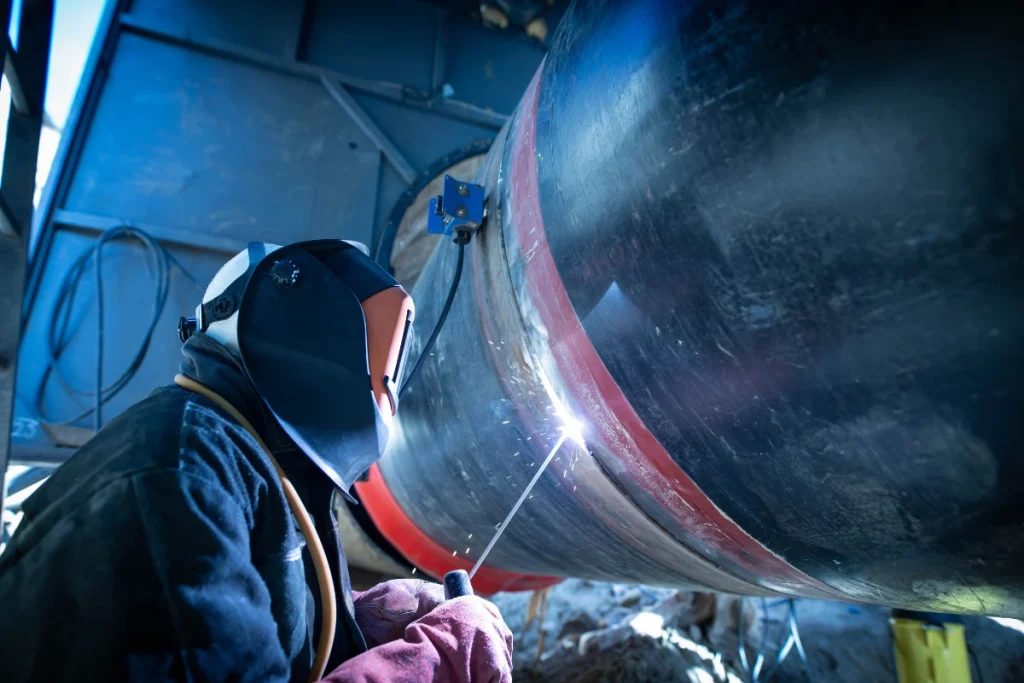
Key features of TIG welding machines:
- Precise weld control: Ensures high quality on thin materials through arc stability.
- Versatile use: Compatible with various metals such as stainless steel, aluminum, and titanium.
- Energy efficiency: Offers low power consumption and high performance with inverter technology.
- Clean weld seam: Produces no slag, leaving a smooth surface that requires no post-treatment.
- Quiet and vibration-free operation: Increases operator comfort and is suitable for long-term use.
- Industrial durability: Features a robust body structure and cooling system for long service life under tough working conditions.
What is a TIG Welding Machine?
Arc-based systems that join metal parts with controlled heat input are preferred in applications requiring precision workmanship. The method, operating with a tungsten electrode and shielding gas, aims to achieve a balanced joint in thin sections.
The reason for preferring this method is the need to maintain surface integrity by keeping heat within a narrow area. Thanks to proper current management, the risk of deformation decreases and a consistent structure forms along the joint line.
During operation, a stable arc is created between the electrode and the workpiece, and the molten area is protected with inert gas. The need for filler metal is determined by the operator according to material thickness.
Incorrect current settings or irregular gas flow during application may lead to porosity formation and weak bond strength. Therefore, equipment selection and parameter settings should be considered carefully.
The prominent aspects of the system are as follows:
- Precise amperage adjustment contributing to ease of use helps the operator control arc length in a balanced manner.
- Compatibility with different alloys provides a wide range of applications in workshop and field projects.
- Low spatter rate reduces the need for post-processing while preserving surface cleanliness.
- Stable heat distribution limits the risk of dimensional loss in thin parts.
Welding machines positioned in different segments within the industry vary according to production scale and technical requirements. Proper equipment selection plays a decisive role in long-term efficiency and sustainable operation.
AC DC TIG Welding Machine
Systems offering both alternating and direct current modes provide flexible operation across different metal types. Since the current type can be changed, it is possible to achieve balanced results on materials such as aluminum and steel.
During operation, the operator selects the current mode according to the material type and optimizes the frequency setting. Heat distribution is kept balanced by regulating current transition in a controlled manner.
Incorrect mode selection may lead to weak surface adhesion or excessive heat accumulation. This situation may affect part integrity and create the need for reprocessing.
A welding machine with dual current mode offers the following technical advantages:
- Alternating current adjustment: Creates a cleaning effect on oxidized surfaces and contributes to stable joint progression.
- Direct current mode: Provides controlled depth in narrow areas and forms stronger connections in thick sections.
- Adjustable frequency value: Helps manage heat input precisely by regulating arc intensity.
- Pulse mode option: Reduces burn-through risk in thin materials and enables more controlled progression.
Systems offering versatile mode transitions adapt to different projects in advanced TIG welding applications.